
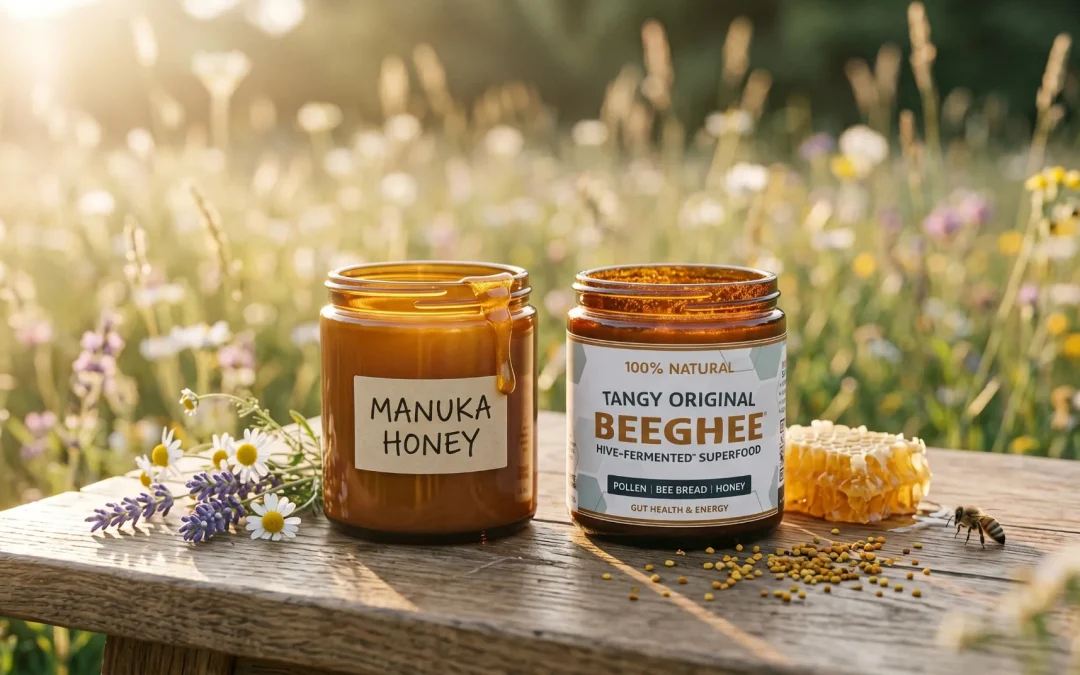
The one-minute guide to knowing which bee medicine you actually need.
Two amber jars sit on the shelf at your local health store. Both from bees. Both marketed as “healing superfoods.” Both expensive enough to make you hesitate.
Here’s what almost nobody explains clearly: Manuka honey and Beeghee do nearly opposite things inside your body.
Once you know the difference, choosing between them — or using both — becomes obvious.
What Manuka Honey Does: Kills Bad Microbes
Manuka honey comes from bees that forage on the Leptospermum bush of New Zealand. It contains a compound called methylglyoxal (MGO), which is responsible for its famously strong antibacterial action. That’s what the UMF or MGO rating on the label actually measures.
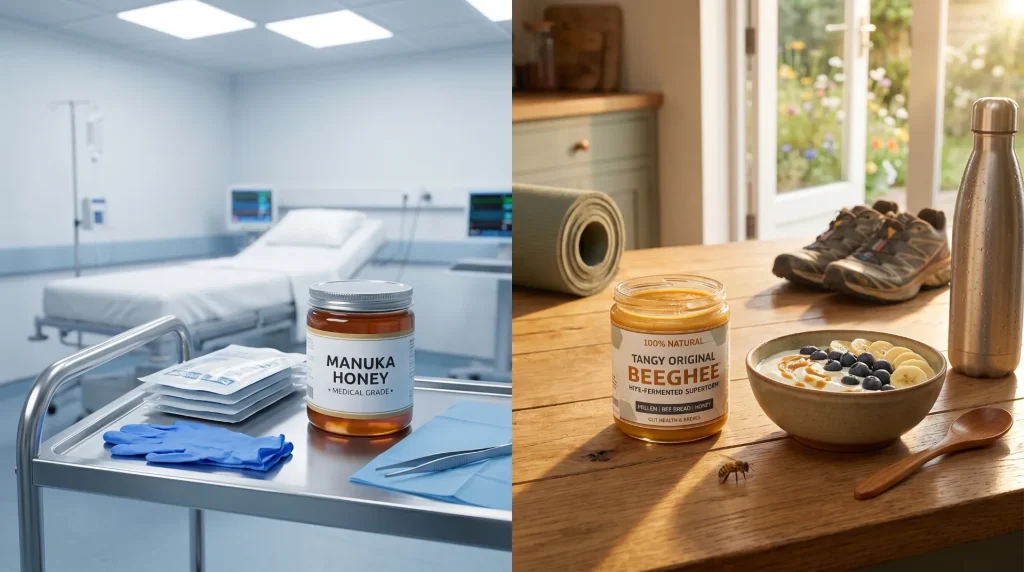
Medical-grade Manuka has been cleared by the FDA as a component of wound dressings since 2007. Hospitals use it on burns, ulcers, and post-surgical wounds. At home, people reach for it when a cold is coming on, a scratchy throat needs coating, or a skin irritation needs calming.
Manuka’s job is simple: make environments hostile to bacteria. That’s what it was selected for, and it does it well.
What Beeghee Does: Delivers Good Microbes
Beeghee is not a honey. It’s hive-fermented bee bread — pollen that bees have mixed with honey, propolis, and their own enzymes, then sealed inside honeycomb cells where beneficial lactic acid bacteria go to work for weeks.
The result is a living probiotic food with:
- Up to 10⁸ CFU/g of beneficial bacteria (Apilactobacillus, Fructobacillus, and others)
- Pre-digested pollen walls that boost bioavailability from roughly 15% to 80%
- A complete amino acid profile you won’t find in any capsule
- B-complex vitamins at levels comparable to premium supplements
Beeghee’s job is different: feed the beneficial microbial ecosystem already inside you.
The Core Difference
Manuka is sterile. Shelf-stable. Inert. That’s a feature — you can’t have live probiotics inside something designed to stop bacterial growth.
Beeghee is living. Still fermenting in the jar when you open it. Full of active enzymes and microbes doing real work.
Manuka kills the microbes you don’t want. Beeghee delivers the ones you do.
They’re not competitors. They’re different tools from the same hive.
Which One Do You Actually Need?
Reach for Manuka when you need to stop something:
- Sore throat or early cold symptoms
- Cut, burn, or skin irritation (medical-grade, applied topically)
- Occasional stomach discomfort linked to bacterial imbalance
Reach for Beeghee when you want to build something:
- Daily gut microbiome support as part of a long-term routine
- A whole-food probiotic that isn’t freeze-dried in a capsule
- Bioavailable pollen nutrition — protein, amino acids, B-vitamins
- Sustained, non-stimulant energy through the afternoon
Why the Confusion Exists
A lot of the confusion in this category comes from a habit in wellness marketing: lumping every “bee product” together as if they’re variations on a theme. They’re not.
Honey is processed nectar. Bee pollen is raw pollen pellets — nutritious but mostly indigestible to humans. Propolis is tree resin used for hive defense. And bee bread is something else entirely: pollen that has been fermented inside the hive for weeks, transformed by microbes into a whole new food.
Manuka is exceptional honey. Beeghee is exceptional bee bread. They live on the same pantry shelf. They do not do the same job.
The Bottom Line
Both have their place. Manuka is a targeted antimicrobial. Beeghee is a daily foundation for gut health.
The hive makes many medicines — humans have been visiting it for remedies for about as long as we’ve been human. Now you know the difference between two of its most important ones.
Your pantry has room for both. Your body has use for both.
This article is for educational purposes and is not medical advice. Beeghee is a food, not a drug. Statements have not been evaluated by the FDA. Beeghee is not intended to diagnose, treat, cure, or prevent any disease. If you are pregnant, nursing, taking medication, or have a medical condition, consult your healthcare provider before adding new foods to your routine.